
Affiliate disclosure: This page contains Amazon affiliate links. As an Amazon Associate ThermalBeast earns from qualifying purchases at no extra cost to you. Full disclosure
The Story Behind the Site
This site came from one of the more extreme PC hardware experiments anyone has attempted in a residential bedroom.
Fifty-five RTX 30-series graphics cards. A 12×12 room. South Florida in summer. And the kind of heat output that makes conventional PC cooling advice completely useless.
What got figured out in that room — through failure, frustration, and eventually a solution that actually worked — is what ThermalBeast is built on.
The 55 GPU Mining Room
At peak operation there were 55 RTX 30-series cards running simultaneously in a single bedroom. A mix of RTX 3080s and RTX 3090s. Two windows. One door. And enough combined heat output to rival a small commercial kitchen running full service.
A single RTX 3080 at full load draws 220 to 320 watts of power — all of which becomes heat. Multiply that by 55 cards and you are generating 12,000 to 17,000 watts of continuous heat in a room the size of a parking space. In South Florida. In summer. With ambient outdoor temperatures in the high 80s and humidity that makes the air feel like warm soup.
What Did Not Work
The standard approach — open-air frames with high-volume fans pointed at the GPU heatsinks — accomplished almost nothing.
Fans move air. They do not remove heat from a room. Every fan added was just circulating 95-degree air across the cards slightly faster. Ambient temperatures climbed past 95 degrees F. GPU junction temperatures hit 100 degrees C. Cards started throttling and shutting down.
A window AC unit brought temperatures down to around 80 degrees F under full load. Better — but window units cycle on and off and GPU temperatures followed every cycle. Still no stability.
What Finally Worked
The fix came from thinking about the room as a complete thermal system rather than a collection of individual components to cool.
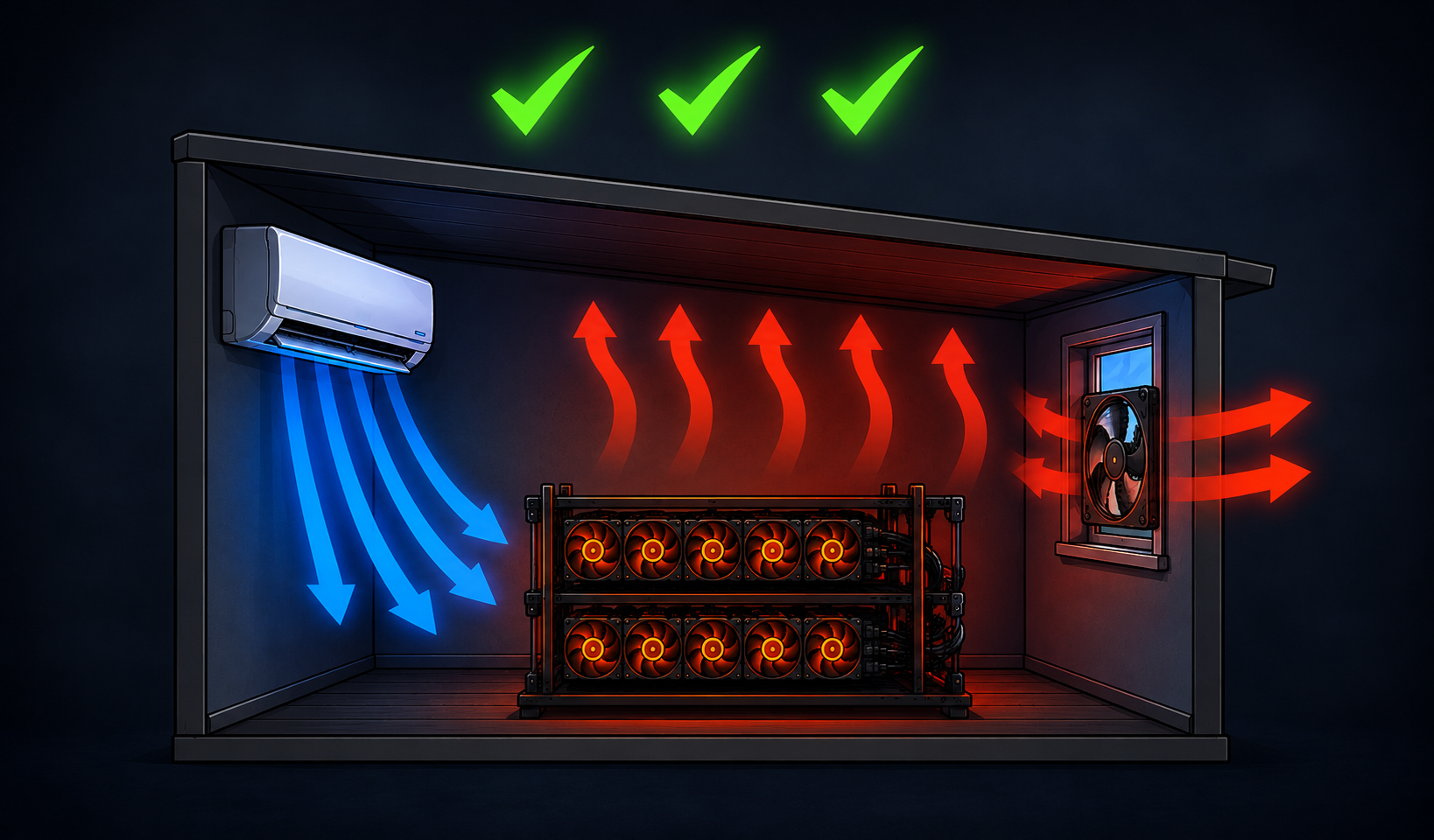
A 1.5-ton ductless mini split positioned to blow cold air directly down onto the GPU rows. Cold air falls naturally across the heatsinks, absorbs heat, and rises toward the ceiling. Standard convection doing what physics intended.
But rising hot air in a sealed room just recirculates. It needs somewhere to go.
A whole-house exhaust window fan mounted in one of the windows pulled the rising hot air out continuously and pushed it outside. Replacement air came in through door gaps and the second window.
Cold air in at GPU level. Hot air out at ceiling level. A complete thermal loop.
The room stabilized. GPU temperatures dropped by double digits. The operation ran reliably and stayed running.
Why This Site Exists
After winding down the mining operation there was an unusual amount of practical knowledge sitting around that does not exist anywhere online in one place.
Real thermal management experience from keeping 55 GPUs alive under conditions they were never designed for. Hard-won lessons about what actually matters in a cooling setup versus what sounds good on paper. And a very clear sense of which products earn their place and which ones are marketing.
Most PC building sites are written by enthusiasts who built a gaming PC last year and enjoy hardware as a hobby. That is genuinely valuable. But it is a different kind of knowledge than what you find here.
ThermalBeast is for the person who wants to understand why, not just what. Why case pressure matters. Why ambient temperature sets your thermal ceiling. Why exhaust fan placement matters as much as CPU cooler quality. Why some components fail early and others run for years.
The answers come from real experience at real scale under real stress.
What You Will Find Here
Cooling Guides — Airflow, thermal paste, GPU undervolting, room temperature management using tools like mini splits and exhaust fans, fan curve tuning, and direct lessons from running 55 GPUs at scale that apply to every build.
PC Build Guides — Complete builds from $500 to $2,000 with every component justified, every thermal decision explained, and Amazon links for everything from CPU coolers to power supplies to cases.
GPU Reviews — Honest assessments of cards like the RX 9070 XT, RTX 4070 Super, and RTX 3080 with particular attention to thermal performance and long-term reliability.
Best Picks — Curated recommendations including the Fractal Design Torrent for airflow, the Deepcool AK620 for CPU cooling, and Thermal Grizzly Kryonaut for thermal paste — all chosen based on performance, reliability, and value.
Products Mentioned on This Page
- NVIDIA RTX 3080 — The card that started it all
- NVIDIA RTX 3090 — The flagship we ran at scale
- 18,000 BTU Ductless Mini Split — The solution that fixed everything
- 12,000 BTU Ductless Mini Split — Right size for a gaming room
- Whole House Window Exhaust Fan — The second piece of the puzzle
- Fractal Design Torrent — Best airflow case available
- Fractal Design Focus 2 — Best budget airflow case
- Deepcool AK620 — Best value CPU air cooler
- Deepcool AK400 — Best budget CPU cooler
- Thermal Grizzly Kryonaut — Best thermal paste
- Corsair RM750e — Best value PSU
Get in Touch
Questions about a build, a cooling problem, or anything hardware related — reach out here.
ThermalBeast participates in the Amazon Services LLC Associates Program. When you click a product link and make a purchase on Amazon a small commission is earned at no extra cost to you. Recommendations are based on performance and value only. Payment is never accepted for placement or positive coverage. Full affiliate disclosure